

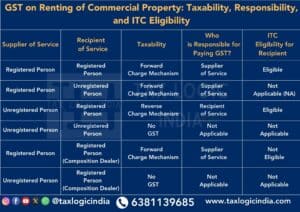
The Goods and Services Tax (GST) on renting of commercial property is an important topic for property owners, businesses, and tax consultants alike. With changing GST norms and compliance requirements, understanding the taxability, the responsibility for paying GST, and the eligibility for Input Tax Credit (ITC) is crucial. Here, we break down the key scenarios to help you navigate GST regulati
ons effectively.
Understanding GST on Commercial Property Renting
Renting of commercial property is considered a taxable supply under GST law. Whether the G
ST applies and how it is handled depends on the registration status of the service provider (supplier) and the recipient (tenant). It is also influenced by whether the transaction falls under the Forward Charge Mechanism (FCM) or the Reverse Charge Mechanism (RCM).
GST Rate: The applicable GST rate on renting of commercial property is 18%.
Effective Start Date: GST on renting of commercial property has been applicable since July 1, 2017, when GST was first introduced in India.
Below, we explore the various scenarios in detail:
Scenarios for GST Applicability on Renting of Commercial Property
1. Registered Supplier and Registered Recipient
- Taxability: GST is charged at 18% under the Forward Charge Mechanism (FCM).
- Who Pays the GST?: The supplier (landlord) is responsible for charging and paying GST to the government.
- ITC Eligibility: The recipient (tenant) can claim ITC on the GST paid, provided the property is used for business purposes.
2. Registered Supplier and Unregistered Recipient
- Taxability: GST is charged at 18% under the Forward Charge Mechanism (FCM).
- Who Pays the GST?: The supplier is responsible for paying GST.
- ITC Eligibility: Not applicable, as the recipient is not registered under GST.
3. Unregistered Supplier and Registered Recipient
- Taxability: GST is applicable at 18% under the Reverse Charge Mechanism (RCM).
- Who Pays the GST?: The recipient (tenant) is responsible for paying GST directly to the government.
- ITC Eligibility: The recipient can claim ITC on the GST paid, provided the property is used for business purposes.
4. Unregistered Supplier and Unregistered Recipient
- Taxability: No GST is applicable in this scenario.
- Who Pays the GST?: Not applicable.
- ITC Eligibility: Not applicable.
5. Registered Supplier and Recipient under Composition Scheme
- Taxability: GST is charged at 18% under the Forward Charge Mechanism (FCM).
- Who Pays the GST?: The supplier is responsible for paying GST.
- ITC Eligibility: The recipient under the Composition Scheme is not eligible to claim ITC.
6. Unregistered Supplier and Recipient under Composition Scheme
- Taxability: No GST is applicable in this scenario.
- Who Pays the GST?: Not applicable.
- ITC Eligibility: Not applicable.
What is the Forward Charge Mechanism (FCM)?
Under the Forward Charge Mechanism, the supplier of the service is responsible for collecting GST from the recipient and depositing it with the government. This is the default mechanism for most transactions under GST law.
What is the Reverse Charge Mechanism (RCM)?
Under the Reverse Charge Mechanism, the recipient of the service is required to pay GST directly to the government instead of the supplier. This mechanism is used in specific cases, such as when the supplier is not registered under GST.
Input Tax Credit (ITC) Eligibility
ITC is a key feature of the GST regime that allows businesses to claim credit for the GST paid on inputs used for business p
urposes.
- Eligible Scenarios: ITC is available when the recipient is registered under GST, and the commercial property is used for taxable business activities.
- Non-Eligible Scenarios: ITC cannot be claimed by unregistered recipients or recipients under the Composition Scheme.
Important Points to Remember
- GST Rate: The standard GST rate on renting of commercial property is 18%.
- Effective Date: GST on renting of commercial property has been in effect since July 1, 2017, the date GST was implemented in India.
- Registration Requirement: Both the supplier and recipient must assess their GST registration status to determine their obligations.
- Exemptions: GST does not apply to the renting of residential properties used for personal purposes, as these are classified as exempt supplies.
- Invoices: Suppliers must issue proper tax invoices, including GST details, to ensure compliance and enable ITC claims.
Practical Examples
- Scenario 1: A registered company rents office space from a registered property owner. The landlord charges 18% GST under the Forward Charge Mechanism, and the company can claim ITC.
- Scenario 2: A small business under the Composition Scheme rents a shop from an unregistered landlord. In this case, GST is not applicable, and no ITC is available.
Conclusion
Understanding the GST rules for renting commercial property is essential for compliance and financial planning. Whether you are a property owner or a tenant, being aware of your responsibilities under GST law can help you avoid penalties and take advantage of ITC where applicable.
For any doubts or assistance, consult a GST expert or refer to the latest GST notifications and circulars issued by the government. Staying informed is the key to hassle-free compliance in the dynamic world of GST.
for more details contact us : 91- 6381139685